Thursday, November 9, 2017

Plastic pellets are considered as marine debris pollutants (Gregory, 1977). They can be defined as small granules or raw materials that will be melted and molded into plastic products that can be found stranded on the beaches all over the world. It has several shapes and colors. Their shapes are in the form of tablet, oblong, cylindrical, spherical and disk shape, whereas the color are white including clear and transparent, black, blue, yellow, purple, red, green, brown, grey and pink. Usually, plastic pellets (Fig. 1) can be found in the environment due to the spillage during shipping loading and unloading. Since, plastic pellets are made of plastic, which is primary synthetic organic polymer derived from petroleum. Therefore, when it is exposed to UV radiation in sunlight and water from the ocean, this polymer will break into smaller pieces. This process will take time to occur naturally. http://www.ukm.my/msab/VOL%2038%20NO%201%20June%202009%20PDF/85%20-%2088%20%20%20Ismail%20%20A.pdf

GNH12_Nurdles found near Edinburgh
http://blog.positiveluxury.com/2016/01/06/nurdles-plastic-pellets-silently-polluting-oceans/

Plastic pellets are considered as marine debris pollutants (Gregory, 1977). They can be defined as small granules or raw materials that will be melted and molded into plastic products that can be found stranded on the beaches all over the world. It has several shapes and colors. Their shapes are in the form of tablet, oblong, cylindrical, spherical and disk shape, whereas the color are white including clear and transparent, black, blue, yellow, purple, red, green, brown, grey and pink. Usually, plastic pellets (Fig. 1) can be found in the environment due to the spillage during shipping loading and unloading. Since, plastic pellets are made of plastic, which is primary synthetic organic polymer derived from petroleum. Therefore, when it is exposed to UV radiation in sunlight and water from the ocean, this polymer will break into smaller pieces. This process will take time to occur naturally.

Another contribution on safety, health and environment at Petronas.Kertih.

No automatic alt text available.
Image may contain: 3 people, people sitting

Tuesday, November 7, 2017

Many years I involved in this series of science film festival (SFF), I am still cannot mobilise university's students to produce one film that can compete in the SFF. We have been talking on science, innovation and STEM (Science, technology, engineering and mathematics) BUT we are still at the beginning.

http://www.goethe.de/ins/th/prj/wif/enindex.htm?wt_sc=sciencefilmfestival

Anthropocene - Welcome to the Human Age

The Science Film Festival received 200 films from 35 countries this year. Over 40 international science educators and science communicators selected the films to be screened at the event. In total, 67 films were chosen as finalists in the festival program. The international official selection of the Science Film Festival 2017 can be found in our FILMS section.
The festival is a celebration of science communication and enjoys a unique position in Southeast Asia, South Asia, Africa and the Middle East: In cooperation with local partners it promotes science literacy and awareness of contemporary scientific, technological and environmental issues through international film and television content with accompanying educational activities. The event has grown steadily since its first edition in 2005, becoming the largest event of its kind worldwide with nearly one million visitors.
The Science Film Festival 2017 takes place in 23 countries from October 6 to December 18. Please note that the festival period and film selection differs from country to country so please click on the country of interest from the map below for more detailed local information.

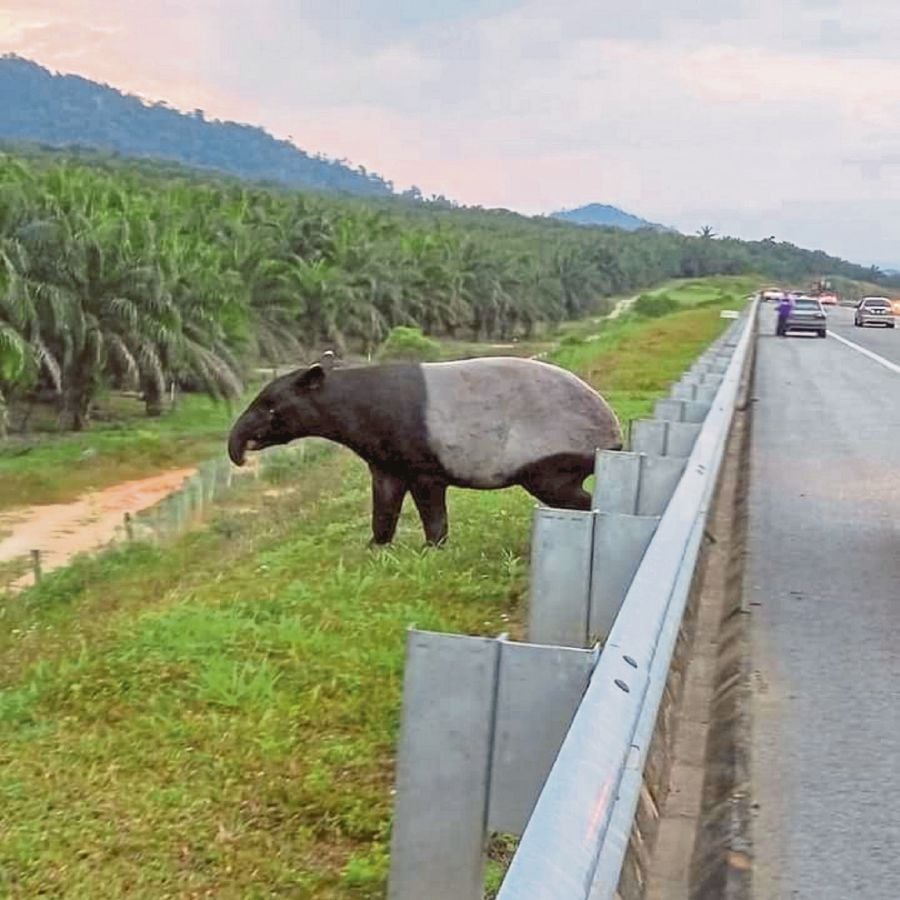
Tapir's death: Saving wildlife from roadkill. All Malaysian especially the authorities involve must responsible for this. may be public do not read what I have written and commented in the news papers about tapir conservation. At least all KPA teachers can say something in their face book to show their concern. SAVE WILDLIFE

https://www.nst.com.my/opinion/letters/2017/10/296533/tapirs-death-saving-wildlife-roadkill

Sunday, November 5, 2017

We need to understand the sensitive animals that might extinct when their habitat become smaller and increase human-willdlife conflicts.

No automatic alt text available.
The Gaur (Seladang) "Bos gaurus" (right) is the largest of all species of cattle. In Peninsular Malaysia, "Bos gaurus hubbacki was once fairly common when lowland rainforest was more widespread, but has now greatly declined. Although captive breeding has been initiated by the Department of Wildlife and National Parks since 1982, degradation of lowland rainforest and poaching are serious issues to be addressed as far as long term survival of this species is concerned. "Bos gaurus readei" of northern Thailand and Indo- China has greatly declined. In south and central India, Nepal, and Bhutan, the nominate "Bos gaurus gaurus" is still stable with viable breeding populations. The deadly foot and mouth disease which ungulates are prone to is another serious threat to both wild and captive populations. We hope that ongoing efforts to save this magnificent ox will succeed. The younger generations would not want to remember the seladang from books and stories told by older generations. See figure below of size in comparison with the Cape Buffalo "Syncerus caffer" (left) of sub-Saharan Africa.