
Thursday, January 23, 2014

Wednesday, January 22, 2014


Tuesday, January 21, 2014
The results of a study on reproductive health, published in the British Medical Journal, revealed that one in 200 US women claim to have given birth without ever having had sexual intercourse.The BMJ reports that of the women who took part in the study, 45 (0.5%) reported at least one virgin pregnancy, "unrelated to the use of assisted reproductive technology".The BMJ article notes that virgin births, or parthenogenesis (from the Greek parthenos for virgin and genesis for birth), can occur in non-humans as a consequence of "asexual reproduction, where growth and development of the embryo occurs without fertilisation". THIS REALLY CHALLENGE NEW SCIENCE!!!

Friday, January 17, 2014
Malaysia is fattest country in South-East Asia; UK-based poverty and disaster relief group ranked Malaysia 44th out of a list of 125 countries; about 2.6 million Malaysians aged 18 and above were diabetics. This number is projected to hit 4.5 million by 2020; In South-East Asia, Malaysia came in second behind Thailand, which ranked 42nd worldwide.Its neighbours, The Philippines (67th), Vietnam (71st), Indonesia (83rd) and Laos (112nd) followed.
;
Do we need kang kung for fiber and diabetic control? The Prime Minister was right giving example kang kung
Do we need kang kung for fiber and diabetic control? The Prime Minister was right giving example kang kung
Thaipusam (Tamil: தைப்பூசம், Taippūcam ?)is a Hindu festival celebrated mostly by the Tamil community on the full moon in the Tamil month of Thai (January/February). It is mainly observed in countries where there is a significant presence of Tamil community such as India, Sri Lanka, Malaysia, Mauritius Singapore, Thailand and Myanmar: Holliday in Malaysia not just for Hindus but for all!.


Instead of talking ad laughing about kangkung, better we grow kangkung. practice urban agriculture. plant kangkung in polybag infront of our house. Between 40-60 day intervals once a week plucking. If they are well maintained we can produce 10-16 tons / ha. Kangkung is a highly nutritious plant with high levels of protein, calcium, iron, potassium, & vitamins A B & C. A valuable addition to the diet..


Ipomoea aquatica (Kangkung): Ipomoea aquatica is a semiaquatic, tropical plant grown as a leaf vegetable. It is found throughout the tropical and subtropical regions of the world, although it is not known where it originated. This plant is known in English as Water spinach, River spinach, Water morning glory, Water convolvulus, or by the more ambiguous names "Chinese spinach", "Swamp cabbage" and "Kangkong" in Southeast Asia. Refer to wikipedia and learn how to grow kangkung. by now we have enough kangkung to export instead of makig noise and laughing in the internet. Wake up!!!!
http://en.wikipedia.org/wiki/Ipomoea_aquatic
Good to control diabetic too: Studies conducted with pregnant diabetes-induced rats have shown a blood sugar lowering effect of Ipomoea aquatica by inhibiting the intestinal absorption of glucose.

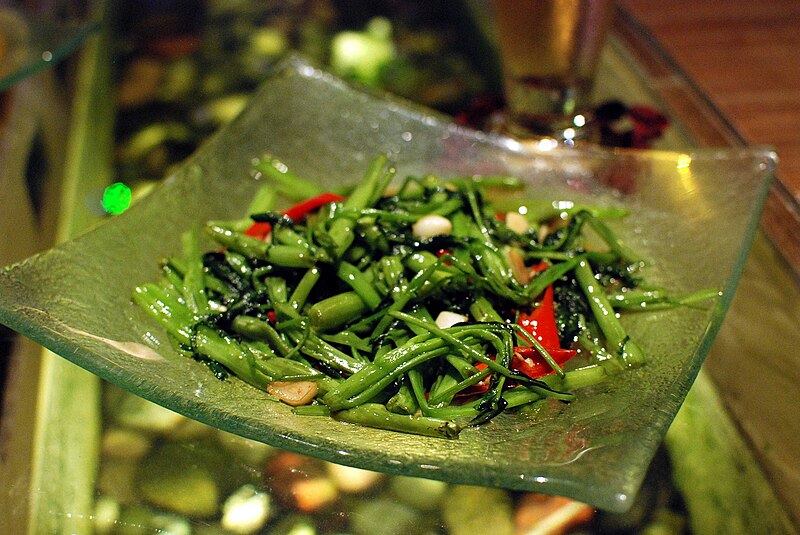
Good to control diabetic too: Studies conducted with pregnant diabetes-induced rats have shown a blood sugar lowering effect of Ipomoea aquatica by inhibiting the intestinal absorption of glucose.


Subscribe to:
Posts (Atom)